Best Lab-Grown Diamond Stud Earrings Under $500 for Sustainability-Minded Women in Fall 2026 (Recycled-Gold, Certified & Honestly Compared)
Editorial Research Roundup — compiled from secondary sources, not personal hands-on testing. This guide synthesizes retailer product pages, expert coverage (Forbes Vetted, Fox News Deals), gemological grading standards (IGI/GIA), and each brand’s own public sustainability reporting. We have not personally worn or lab-tested every pair. Where the sourcing is clear we present it directly; where trade-offs exist we flag them. As an affiliate for the brands named below, BestUnderPick may earn a commission on qualifying purchases at no extra cost to you. Prices confirmed on brand DTC pages on August 26, 2026 — verify at checkout, since diamond pricing and promos shift.
Here is the part that stops most shoppers mid-scroll: you can now buy a pair of real, certified diamond studs — grown in a lab, set in recycled gold — for right around $450, not the $2,000-plus that “diamond studs” used to imply. And no, “lab-grown” does not mean fake. Per IGI and GIA grading standards, a lab-grown diamond is chemically, physically, and optically the same material as a mined one; the only difference is origin. If you are sustainability-minded and have been circling a diamond upgrade for a while — wanting the sparkle without the mining, and the recycled-metal receipts to back it up — this roundup is built for you.
We pulled together four core pairs that all land in the $350–$500 band, cross-checked their certifications and each brand’s published sourcing claims, and lined up the honest trade-offs side by side. The short version, per our comparison of current DTC listings: Brilliant Earth’s Perfect 4-Prong studs at $450 carry the most complete eco story of the group — recycled 18K gold plus carbon-neutral operations — which is why coverage like Forbes Vetted tends to tag the brand “most sustainable.” But the biggest stone for the money, the classic look, and the delicate everyday option each go to a different pick. Here is how they actually compare.
How This Guide Was Compiled
Our method is transparent by design, because “sustainable” is a word that gets stretched thin in fine-jewelry marketing. Four steps:
- Retailer + expert roundup aggregation. We read how Forbes Vetted (Molly Calhoun, Deputy Editor), Fox News Deals, and specialist blogs (Rosec Jewels, Mansi Jewelry, Beyond Carat) frame the “lab-grown diamond earrings under $500” category — which brands recur, and which trade-offs they surface.
- Direct DTC price and spec verification. Every price, carat weight, metal, color, and clarity grade below was read off the brand’s own product page on August 26, 2026 — not lifted from an aggregator.
- Certification cross-check. We confirmed each core pick is graded to a recognizable standard (IGI-certified stones, brand-stated color/clarity ranges) per IGI/GIA definitions of what a lab-grown diamond is.
- Sustainability-claim sourcing. We only repeat eco credentials the brand publishes itself — Brilliant Earth’s carbon-neutral and recycled-metal reporting, Clean Origin’s recycled-metals and conflict-free positioning, Blue Nile’s diamond-sustainability and trade-in policies. No unverified “eco-friendly” labels.
To be explicit: we have not personally carried or worn every pair in this guide. Where the certification and sourcing are documented, we present that directly. Where a claim is softer — as “sustainable” often is — we say so.
Quick Comparison: Four Lab-Grown Diamond Studs Under $500
| Pick (label) | Brand | Carat (tw.) | Metal | Color / Clarity | Certification | Price | Sustainability tag (per brand) |
|---|---|---|---|---|---|---|---|
| Top Pick — Most Sustainable | Brilliant Earth | 1/2 ct. | 18K recycled white gold | brand-stated premium | Third-party certified | $450 | Carbon-neutral + recycled metals + Beyond Conflict Free |
| Best Value — Most Carat/$ | Clean Origin | 3/4 ct. | 14K white gold (3-prong) | G/H · VS | IGI certified | $450 | Recycled metals + conflict-free |
| Best Classic Four-Prong | Clean Origin | 3/4 ct. | 14K white gold (4-prong) | G/H · VS | IGI certified | $465 | Recycled metals + conflict-free |
| Best Everyday Petite | Blue Nile | 1/4 ct. | 14K yellow gold | F-G · VS2-SI1 | Certified | $460 | Lab-grown (no mining) + trade-in program |
All four are single-retailer DTC purchases, which keeps sizing, returns, and warranty terms straightforward. Now the picks in detail.
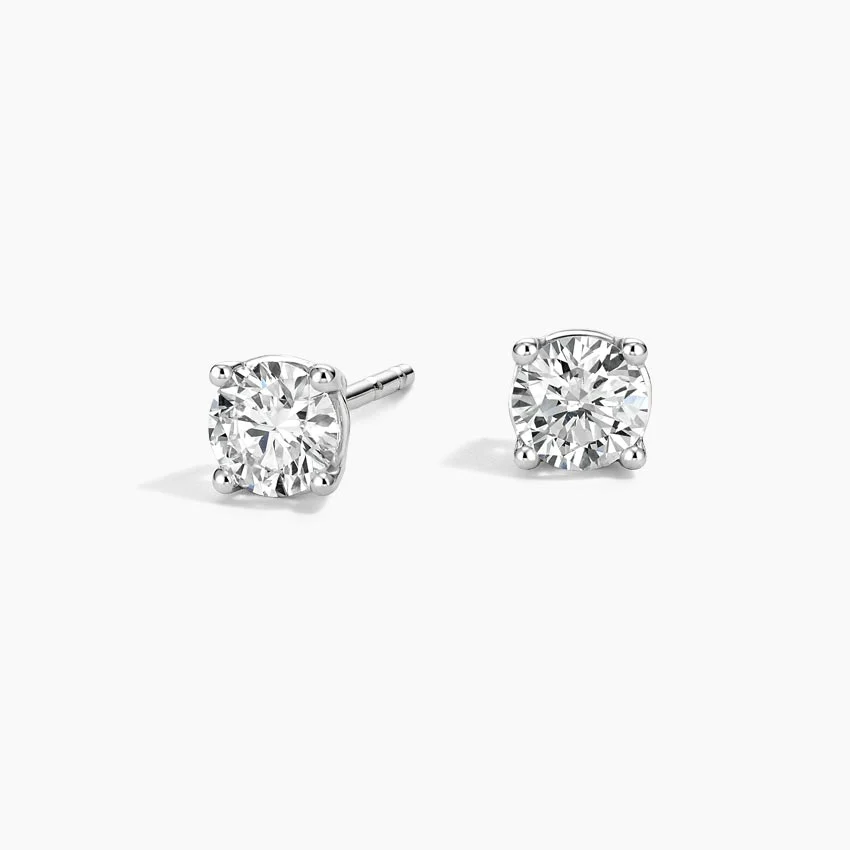
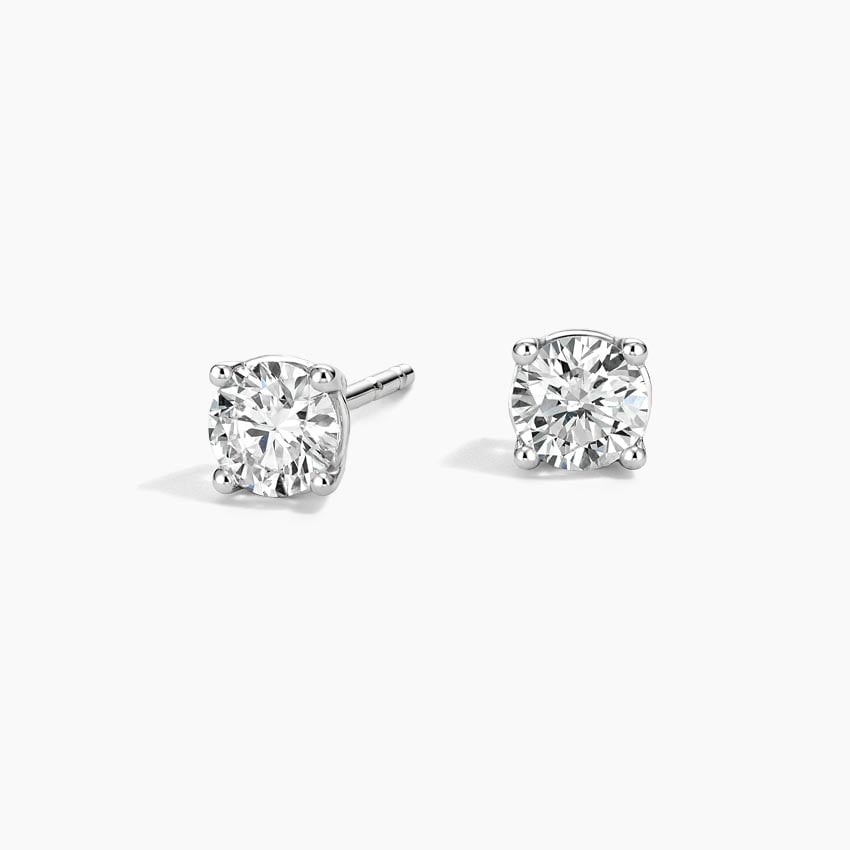
Top Pick — Most Sustainable: Brilliant Earth Perfect 4-Prong Lab Diamond Studs, 1/2 ct. tw., 18K White Gold — $450
If your priority is the cleanest documented sourcing rather than the biggest stone, this is the pair to beat. Per Brilliant Earth’s published sustainability reporting, the house pairs recycled 18K gold with carbon-neutral operations and its “Beyond Conflict Free” sourcing framework — the reason roundups such as Forbes Vetted repeatedly hand the brand the “most sustainable” label in this category. The studs themselves are a half-carat total weight of round-brilliant lab diamonds in a four-prong basket, the setting most people picture when they think “diamond studs.”
What reviewers and coverage praise
- The eco receipts are the most complete of the four, per the brand’s own impact and sourcing disclosures — recycled metal plus carbon-neutral operations, not just “lab-grown, therefore green.”
- 18K gold reads slightly richer and more substantial than 14K at the same carat, which matters if the metal, not just the stone, is part of the appeal.
- Third-party certified stones and an established returns/warranty structure, consistent with how Forbes Vetted frames the brand.
Recurring complaints (honest)
- You pay for the 18K. At the same 1/2 ct. tw., an 18K pair costs more than a comparable 14K pair — you are partly buying the metal story.
- Half a carat reads modest on larger lobes. Per the general sizing consensus in expert roundups, 1/2 ct. tw. is tasteful rather than head-turning.
- Backs: this style ships with friction (push) backs rather than screw-backs, which some daily-wear buyers prefer to upgrade.
Shop the Perfect 4-Prong Lab Diamond Studs 1/2 ct 18K White Gold →
Best fit for: the sustainability-minded buyer who wants the most documented recycled-gold-plus-carbon-neutral story in the under-$500 band, and is happy trading a little size for that.
Best Value — Most Carat per Dollar: Clean Origin Certified Round 3-Prong Studs, 3/4 ct. tw., 14K White Gold — $450

Same $450 as our top pick — but a noticeably bigger stone. This Clean Origin pair delivers 3/4 ct. tw., the largest carat weight of any core pick here, in a modern three-prong 14K white-gold setting. Per Clean Origin’s product spec and IGI grading, the stones run G/H color, VS clarity, and the brand backs the purchase with recycled metals, a 60-day no-questions return window, and a lifetime warranty. If your instinct is “I want the most diamond my budget allows, with the sourcing still on the record,” this is the math winner.
What reviewers and coverage praise
- Most stone for the money in the set — per the product spec, 3/4 ct. tw. at $450 beats the size-per-dollar of every other in-band pick.
- The three-prong setting lifts the stone and lets in a bit more light, a look that skews contemporary.
- 60-day returns and lifetime warranty, which lowers the risk of buying studs you cannot inspect in person — a point specialist roundups like Rosec Jewels weight heavily.
Recurring complaints (honest)
- Three prongs show a touch more metal at certain angles than a four-prong basket — a style call, not a flaw.
- G/H color is a shade warmer than premium D-F; near-colorless, but not icy-white if that is your benchmark.
- Back type varies by stock (screw vs. friction), so confirm which you are getting for daily wear.
Shop the Certified Round 3-Prong Studs 3/4 ct 14K White Gold →
Best fit for: the value-focused, sustainability-minded shopper who wants maximum certified carat weight and a generous return policy over the last word in metal prestige.
Best Classic Four-Prong: Clean Origin Certified Round 4-Prong Studs, 3/4 ct. tw., 14K White Gold — $465

This is the same brand, same 3/4 ct. tw., same G/H · VS · IGI-certified stone as the value pick — but in the timeless four-prong basket most buyers picture when they say “diamond studs.” For $15 more than the three-prong, you are buying silhouette, not size. That makes pairs #2 and #3 a genuinely useful teaching moment: identical stone and price tier, two different looks, so the choice comes down to whether you want the contemporary three-prong or the classic four.
What reviewers and coverage praise
- The four-prong basket is the safe, universal look — it flatters most face shapes and never dates, which is why it dominates traditional stud roundups.
- Same certified spec as the value pick (3/4 ct., G/H, VS, IGI, recycled metals) — you are not trading quality for the classic setting.
- 60-day returns carry over, keeping the online purchase low-risk.
Recurring complaints (honest)
- Four prongs can snag on hair, scarves, and knitwear — worth knowing heading into sweater season.
- G/H color is the same warm-of-icy trade-off as the three-prong.
- The friction-post variant is less secure than a screw-back for all-day, everyday wear.
Shop the Certified Round 4-Prong Studs 3/4 ct 14K White Gold →
Best fit for: the buyer who wants the classic, timeless four-prong diamond stud — with recycled-metal, IGI-certified sourcing — and does not mind paying a few dollars more for the traditional silhouette.
Best Everyday Petite / Yellow Gold: Blue Nile Four-Prong Round Brilliant Lab-Grown Studs, 1/4 ct. tw., 14K Yellow Gold — $460
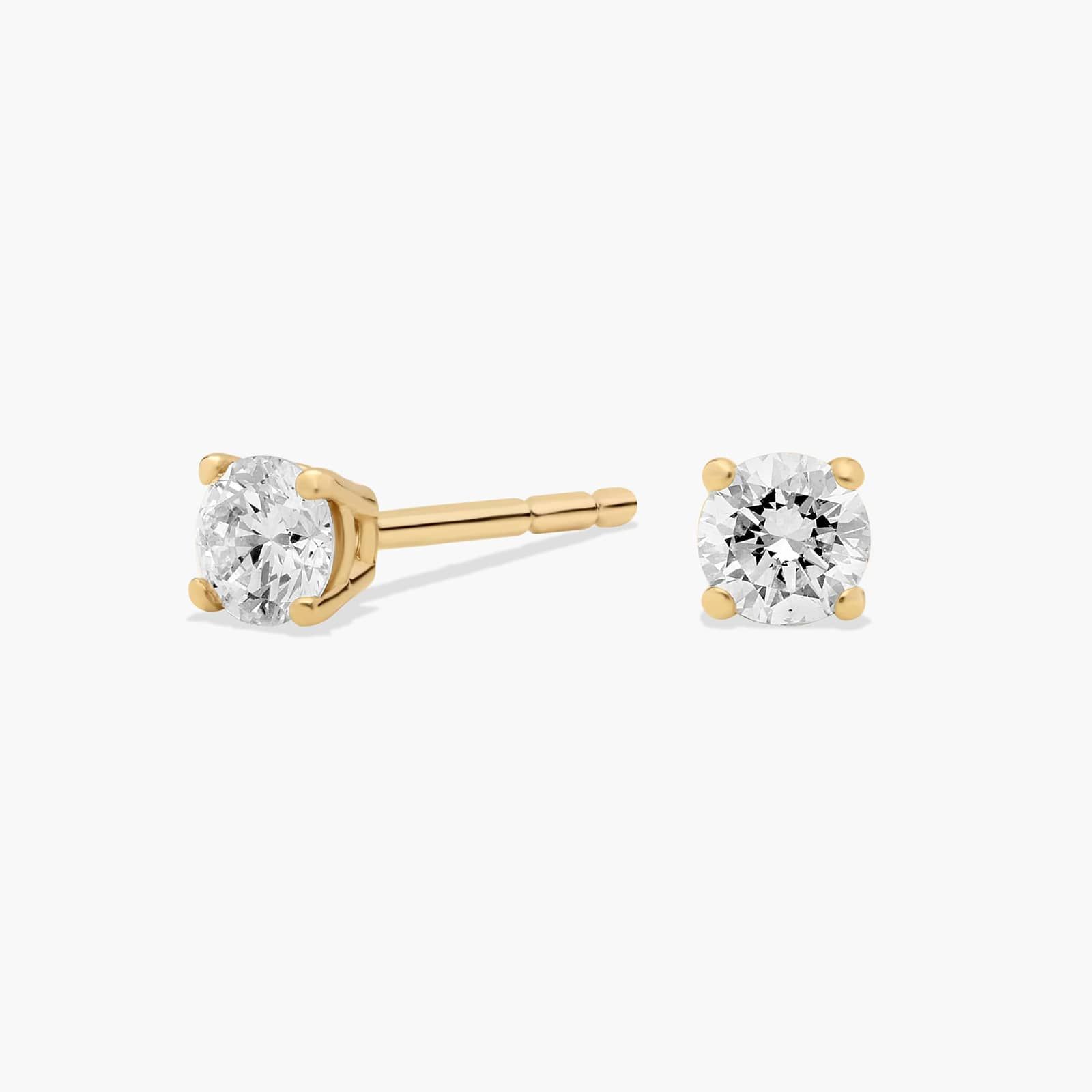
Not everyone wants a statement stud. If you layer earrings, wear studs to the office daily, or simply prefer warm-toned metal, this Blue Nile pair is the delicate, wear-with-everything option — and the only yellow gold and the only true starter size in our set. It is 1/4 ct. tw. of round-brilliant lab diamonds in a 14K yellow-gold four-prong, graded F-G color, VS2-SI1 clarity. Per Blue Nile’s published policies, the pair is lab-grown (no mining), conflict-free, and eligible for the brand’s diamond upgrade/trade-in program — a quietly sustainable feature, since it extends the life of the metal and stone rather than retiring them.
What reviewers and coverage praise
- Genuinely everyday — small enough to sleep in, layer, or pair with other earrings without competing.
- Yellow gold and F-G color, the whitest grade range in this roundup, for buyers who want warm metal and cool stone.
- Trade-in / upgrade program and same-day shipping, per Blue Nile’s listing — the upgrade path is the sustainability angle here.
Recurring complaints (honest)
- 1/4 ct. tw. is genuinely petite — this is a starter size, so set expectations if you want visible sparkle across a room.
- $460 for 1/4 ct. reads pricey next to some budget rivals at the same carat; you are paying for the brand, gold tone, and program.
- Push-back is less secure than a screw-back for active daily wear.
Shop the Four-Prong Round Brilliant Lab-Grown Studs 1/4 ct 14K Yellow Gold →
Best fit for: the sustainability-minded minimalist who wants a warm-gold, everyday petite stud with an upgrade program — not a big-carat statement.
What to Look For in Lab-Grown Diamond Studs Under $500
A few practical filters, drawn from how gemological standards and specialist roundups frame the category:
Cut over carat. Under $500, you will land somewhere between 1/4 and 3/4 ct. tw. — the 1 ct.-plus pairs simply clear the budget. Rather than chase raw size, prioritize cut quality and certification; a well-cut 1/2 ct. often out-sparkles a poorly cut larger stone. This is the single most repeated piece of advice across Rosec and Clean Origin’s own buying guidance.
Certification is non-negotiable. Look for IGI-certified stones (or GIA) with stated color and clarity. Per IGI/GIA standards, that certificate is what confirms the stone is a real, graded lab-grown diamond and not an unspecified “diamond simulant” like moissanite or CZ.
Color and clarity, realistically. G/H color (Clean Origin) is near-colorless and reads white in most lighting; F-G (Blue Nile) is a touch whiter. VS-range clarity means any inclusions are invisible without magnification. For studs — small, worn at ear level — you rarely need to pay up for D-F, flawless stones.
Metal: 14K vs. 18K. 14K is more durable and cheaper; 18K is softer, richer in tone, and pricier. Recycled gold in either karat is the sustainability lever — that, not the karat number, is what makes the metal “greener.”
Backs matter for everyday wear. Screw-backs are the most secure for daily, sleep-in studs; friction/push-backs are easier on and off but likelier to loosen. If a pick ships with friction backs, upgrading to screw-backs is a cheap fix.
The Honest Sustainability Picture
Here is where we part ways with the glossier roundups. “Sustainable” is a relative claim, not a guarantee. Yes, lab-grown diamonds avoid the land and community impacts of mining — that is real and well-documented. But growing a diamond is energy-intensive, and how green it actually is depends heavily on the energy source powering the reactor and whether the setting uses recycled metal.
That is why our sourcing rules matter. Per each brand’s public reporting: Brilliant Earth documents carbon-neutral operations plus recycled metals (the fullest story here); Clean Origin states recycled precious metals and conflict-free, IGI-certified stones; Blue Nile publishes diamond-sustainability and conflict-free policies and runs a trade-in program that extends product life. The strongest purist claim in the wider market belongs to VRAI (Diamond Foundry), whose zero-emission foundry is genuinely differentiated — but its base solitaire studs start at $550, just over our cap.
Bottom line: if carbon-neutral-plus-recycled-gold is your bar, Brilliant Earth leads under $500. If recycled metal plus a real return/warranty safety net is enough, Clean Origin delivers more stone for the money. Neither is “zero impact” — and any brand claiming that flatly deserves a second look.
Honorable Mentions — Out of Band (Listed Honestly)
These fall outside our $350–$500 core band but are worth knowing:
- James Allen Four-Prong 0.25 CTW, 14K White Gold — about $192 on sale (list $240). The cheapest way into real lab diamonds, but it sits below our price-band floor, so it is a budget mention rather than a core pick. (Image not CDN-verified this pass.)
- VRAI (Diamond Foundry) Round Brilliant Solitaire Stud — from $550. The strongest sustainability story going (zero-emission foundry + recycled gold), but the base round solitaire clears $500. A purist splurge.
- Mejuri Lab Grown Diamond Round Studs, 0.5 TCW — $648. Made with 94% recycled gold and net-zero-emissions diamonds; Forbes’ value pick for the brand is actually the Bezel Huggies, since these round studs run above band.
FAQ
Are lab-grown diamonds real diamonds? Yes. Per IGI and GIA grading standards, lab-grown diamonds are chemically, physically, and optically identical to mined diamonds — same material, graded on the same color/clarity/cut scales. The difference is origin, not authenticity. They are distinct from simulants like moissanite or cubic zirconia, which are different materials entirely.
Are lab-grown diamond stud earrings worth it under $500? For the sparkle-per-dollar, yes — the category exists precisely because lab-grown pricing puts certified diamonds in reach at this budget, per the retailer coverage we compiled. The trade-off is size: expect 1/4 to 3/4 ct. tw. in this range, not 1 ct.-plus.
Do lab-grown diamonds hold their value? Be realistic. Lab-grown diamonds generally do not appreciate and tend to see weaker resale than mined stones, per broadly reported market coverage. Buy them to wear, not as an investment. Trade-in/upgrade programs (like Blue Nile’s) are the practical way to recapture some value.
How many carats should everyday stud earrings be? For daily, wear-with-everything studs, roughly 1/4 to 1/2 ct. tw. is the sweet spot — noticeable but comfortable and hard to snag. Save the bigger carat weights for occasion pieces. This tracks with the general sizing guidance in specialist stud roundups.
Are lab-grown diamonds actually more sustainable than mined ones? More sustainable in some ways, not automatically “green.” They avoid mining’s land and community impacts, but growing them is energy-intensive, so the real footprint depends on the reactor’s energy source and whether the setting uses recycled gold. That is why we only cite brands that publish specific credentials — carbon-neutral operations, recycled metals, zero-emission foundries — rather than vague “eco-friendly” labels.
Editor’s Pick Recap
For the sustainability-minded shopper hunting certified lab-grown diamond studs under $500 in the luxury/accessories space, the four pairs above cover the real decision points. Brilliant Earth’s 1/2 ct. 18K studs ($450) carry the most complete recycled-gold-plus-carbon-neutral story — our top pick for eco receipts. Clean Origin’s 3/4 ct. three-prong ($450) is the most stone for the money, with the four-prong version ($465) offering the same certified spec in the classic silhouette. Blue Nile’s 1/4 ct. yellow-gold pair ($460) is the delicate everyday option with an upgrade program. Choose by what you value most: documented sourcing, carat-per-dollar, classic look, or petite warmth.
One last note, in keeping with how we work: this is an editorial research roundup, not personal hands-on testing. We compiled retailer listings, expert coverage, certification standards, and each brand’s own published sustainability reporting — and flagged the trade-offs, including the honest limits of the word “sustainable.” Verify current pricing and stock at checkout before you buy.
Related reading: best statement earrings under 150 fall wedding guests 2026
Related reading: best hypoallergenic earrings under 50 tweens teens sensitive ears fall 2026