Best Sustainable Wide-Leg Trousers Under $150 for Sustainability-Minded Women in Fall 2026 (Certifications Decoded, Cost-Per-Wear Checked)
Editorial Research Roundup — compiled from secondary sources, not personal hands-on testing. This guide synthesizes sustainable-fashion coverage (The Good Trade, Good On You, Sustainable Jungle), brand-reported material specs and third-party certifications (GOTS, RWS, GRS, TENCEL/Lenzing), and aggregate verified retailer reviews. We have not personally worn every pair below. Where the label evidence is strong we say so; where a brand only “attests” to a claim without third-party proof, we flag it. As an Amazon Associate and an affiliate for select retailers, BestUnderPick may earn from qualifying purchases at no extra cost to you.
If you have been circling a pair of sustainable wide-leg trousers for fall but keep bouncing off $190 price tags, here is the honest headline: you do not need to spend $200 to dress a wide-leg silhouette responsibly. Every carded pick in this guide lands at or under $150, and four of the five sit under $110. That is the good news.
Now the caveat mainstream roundups tend to skip. Certified-sustainable wide-leg trousers are a bimodal category. The pairs that carry real third-party certification cluster either in a value band (roughly $40 to $110) or a premium band (roughly $170 to $225), and the $105 to $150 “near-cap” zone in between is genuinely thin. Per The Good Trade, Good On You, and Sustainable Jungle coverage across 2025 and 2026, brand after brand skips that middle. So instead of pretending the middle is crowded, this guide shows you the whole field you can actually buy under $150 — mostly value to near-cap — and tells you exactly where the certifications are real versus brand-asserted.
If you want the one-line takeaway: for a genuinely certified pick that sits near the cap, MATE the Label’s organic-cotton wide-leg pant at about $138 is the strongest option; if you are optimizing purely for cost-per-wear, the sub-$100 TENCEL and hemp options below stretch a small budget furthest.
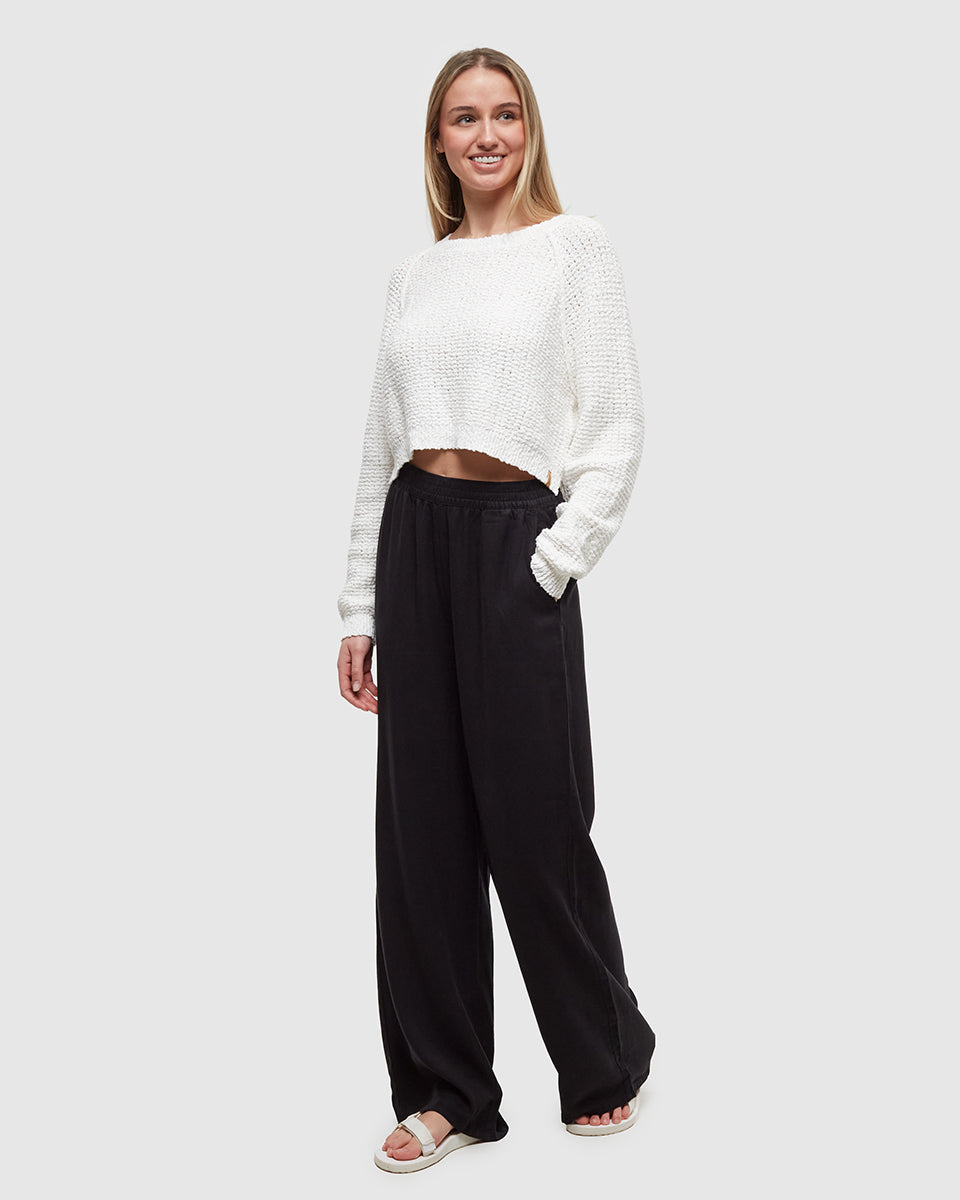
Quick Comparison: Every Pick at a Glance
| Brand & Pick | Silhouette | Key fiber & certification | Sizes | Price (Aug 2026) | Near-cap band? | Cost-per-wear note |
|---|---|---|---|---|---|---|
| MATE the Label — Organic Wide-Leg | Relaxed, high-rise | 100% GOTS organic cotton · B Corp · Climate Neutral | XS–XL | ~$138 | Yes ($105+) | Certified fiber; everyday staple |
| tentree — TENCEL Wide-Leg | Soft-drape, high-rise | 100% TENCEL Lyocell · B Corp | XS–XL | ~$88–$98 | Value tier | Low price + breathable fiber |
| Pact — Stretch Twill Wide-Leg | Structured, everyday | GOTS organic cotton · Fair Trade factory | XS–XXL | ~$68–$79 | Value tier | Machine-wash workwear |
| Quince — Vintage Wash TENCEL | Relaxed, elastic waist | 100% TENCEL (brand-attested; no third-party cert) | XS–XL | ~$49.90 | Budget tier | Cheapest entry; verify claims |
| Toad&Co — Taj Hemp Wide-Leg | Casual, mid-rise ankle | 54% hemp / 44% TENCEL / 2% elastane · B Corp | XS–XL | ~$48.99 sale (reg. ~$95) | Value/sale | Hemp durability + resale |
Prices reflect what retailers listed as of August 2026 and move with sales and stock. Reconfirm at checkout before you buy — a couple of the picks below are sitting on sale prices that will not last.
How This Guide Was Compiled
This is an editorial research roundup, and here is the four-part method behind it, stated plainly so you can weigh the evidence yourself.
First, sustainable-fashion aggregation. We read how the category’s standard-setting outlets — The Good Trade, Good On You, and Sustainable Jungle — frame wide-leg and workwear roundups across their 2025 and 2026 updates, then looked for the gap none of them fill: a hard “under $150” cap paired with cost-per-wear math and certification literacy.
Second, certification and material cross-check. For each pick, we pulled the fiber content and any third-party certifications the brand publishes — GOTS for organic cotton, Fair Trade Certified for factory labor, TENCEL/Lenzing for lyocell, RWS for wool, GRS for recycled content, plus company-level marks like B Corp and Climate Neutral. Where a brand makes an environmental claim without third-party backing, we labeled it “brand-attested.”
Third, aggregate review sampling. Rather than invent first-person testing, we cite the consensus in verified retailer reviews — for example, Toad&Co’s Taj Hemp pant carries roughly 260 reviews, Quince’s TENCEL pant around 238, and MATE’s organic line about 127. Where reviewers repeatedly flag the same fit note (Toad&Co “runs large — size down”), we surface it as reviewer consensus, not personal opinion.
Fourth, price and stock verification as of August 2026, with sale-price flags where relevant.
One honest disclosure, up front: we have not personally carried or worn every product in this guide. Where the label evidence and reviewer consensus are strong, we present that directly. Where the picture is mixed — an uncertified brand, a sale price that may expire, a silhouette that leans more lounge than tailored — we tell you rather than paper over it.
What the Labels Actually Mean
Before the picks, a quick literacy pass, because “sustainable” on a product page means very little on its own. These are the marks worth knowing, per each certifying body’s public standards.
GOTS (Global Organic Textile Standard) certifies that cotton or other natural fiber is organically grown and processed to environmental and social criteria all the way down the supply chain. It is one of the strongest textile marks because it covers both the fiber and the factory. MATE and Pact carry it on the picks below.
Fair Trade Certified is a factory-and-labor mark: it certifies fair wages and working conditions at the sewing facility, not the fiber. Pact’s twill is sewn in a Fair Trade Certified factory.
TENCEL Lyocell (by Lenzing) is a branded lyocell fiber made from wood pulp in a closed-loop process that recaptures most of its solvent. TENCEL is the fiber certification; it says nothing about the factory. tentree, Quince, and Toad&Co all use it.
RWS (Responsible Wool Standard) covers animal welfare and land management for wool — relevant to the premium graduate picks later, not the sub-$150 field. GRS (Global Recycled Standard) verifies recycled content and its chain of custody, common on recycled-polyester blends.
B Corp and Climate Neutral are company-level marks, not product certifications. B Corp audits a company’s overall social and environmental accountability; Climate Neutral verifies measured-and-offset emissions. Useful signals of intent, but they do not certify the specific pants in your cart. “Brand-attested” is our label for a claim a company makes about itself with no independent verification — for example, closed-loop fiber sourcing described only on the brand’s own site. Not automatically false, but it deserves more scrutiny than a GOTS tag.
The practical rule for this persona: treat GOTS, Fair Trade, TENCEL, RWS, and GRS as verified evidence, and treat B Corp, Climate Neutral, and any self-described claim as supporting context rather than proof.
The Picks
Best Near-Cap / Best Organic Cotton — MATE the Label, Organic Wide-Leg Pant (~$138)
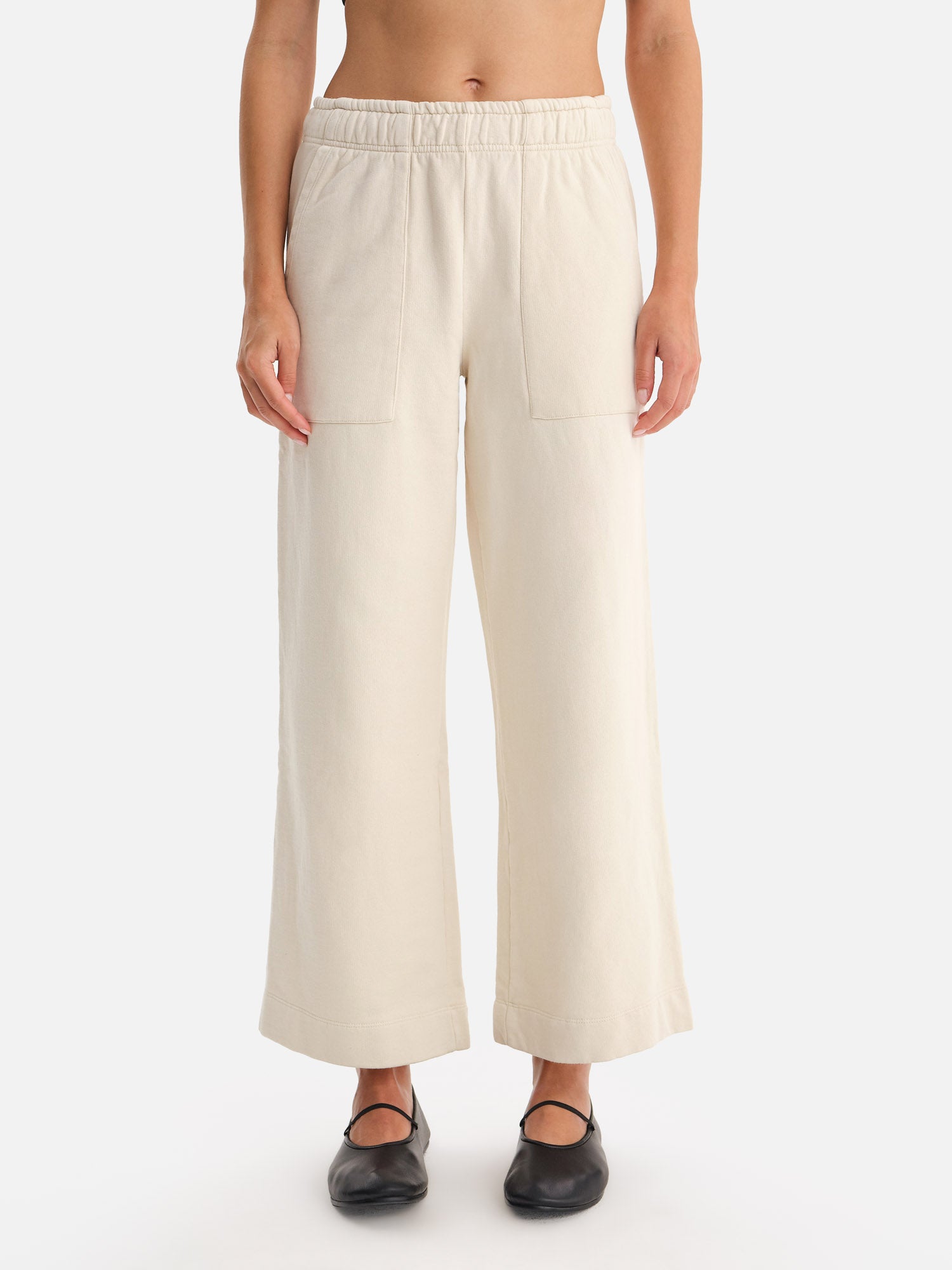
Quick stats: ~$138 · 100% GOTS-certified organic cotton · B Corp + Climate Neutral brand · high-rise with internal drawcord · sizes XS–XL · made in India.
Of everything under $150, this is the pick that clears the near-cap threshold on both price and certification. Per MATE’s published specs, the fabric is 100% GOTS organic cotton dyed with a restricted-substances process (the brand states no pesticides, BPA, PFAS, or formaldehyde), and MATE operates as a certified B Corp and Climate Neutral company. In a category where the certified options usually fall to the value floor or jump past $170, a GOTS pair at $138 is the honest sweet spot.
What reviewers praise: across MATE’s aggregate DTC reviews (roughly 127 on the organic line), the recurring themes are soft hand-feel, a flattering high rise, and true-to-size fit. The internal drawcord earns repeat mentions for comfort.
Recurring caveats: the fleece “Bone” colorway has run out of stock across sizes at times, so link to the in-stock organic-cotton wide-leg variant instead. The silhouette also leans relaxed and lounge-adjacent rather than sharply tailored — worth knowing if you want a crisp office trouser. And MATE’s headline water and carbon savings are the brand’s own Higg-based figures, so we cite them as brand-reported rather than independently audited.
Best fit for: the sustainability-minded reader who wants a real third-party certification and is willing to pay near the cap to get it.
Shop the MATE the Label Organic Wide-Leg Pant →
Best Everyday / Climate Pick — tentree, TENCEL Wide-Leg Pant (~$88–$98)

Quick stats: ~$88–$98 · 100% TENCEL Lyocell · B Corp · high-rise soft drape · sizes XS–XL · ten trees planted per item (brand program).
If the MATE pick is the certified near-cap choice, this is the everyday workhorse. Per tentree’s specs, the fabric is 100% TENCEL Lyocell — a closed-loop, wood-pulp cellulose fiber — and tentree is a certified B Corp that funds tree planting through veritree on each order. The drape is soft and breathable, which makes it read as easy office-casual rather than structured tailoring.
What reviewers praise: breathability, a fluid drape that photographs well, and a comfortable high waist show up repeatedly in verified reviews across tentree’s own site and Target’s listings.
Recurring caveats: TENCEL drapes beautifully but does not hold a sharp crease, so if you want structure this is not it. The price sits in the value tier — below the $105 near-cap floor — so we label it a documented exception rather than a near-cap pick. The tree-planting impact is a brand program, cited as brand-reported.
Best fit for: the reader who wants a certified fiber, an everyday silhouette, and the lowest reasonable price for a legitimately low-impact pant.
Shop the tentree TENCEL Wide-Leg Pant →
Best Value / Fair Trade — Pact, Stretch Twill Wide-Leg Pant (~$68–$79)
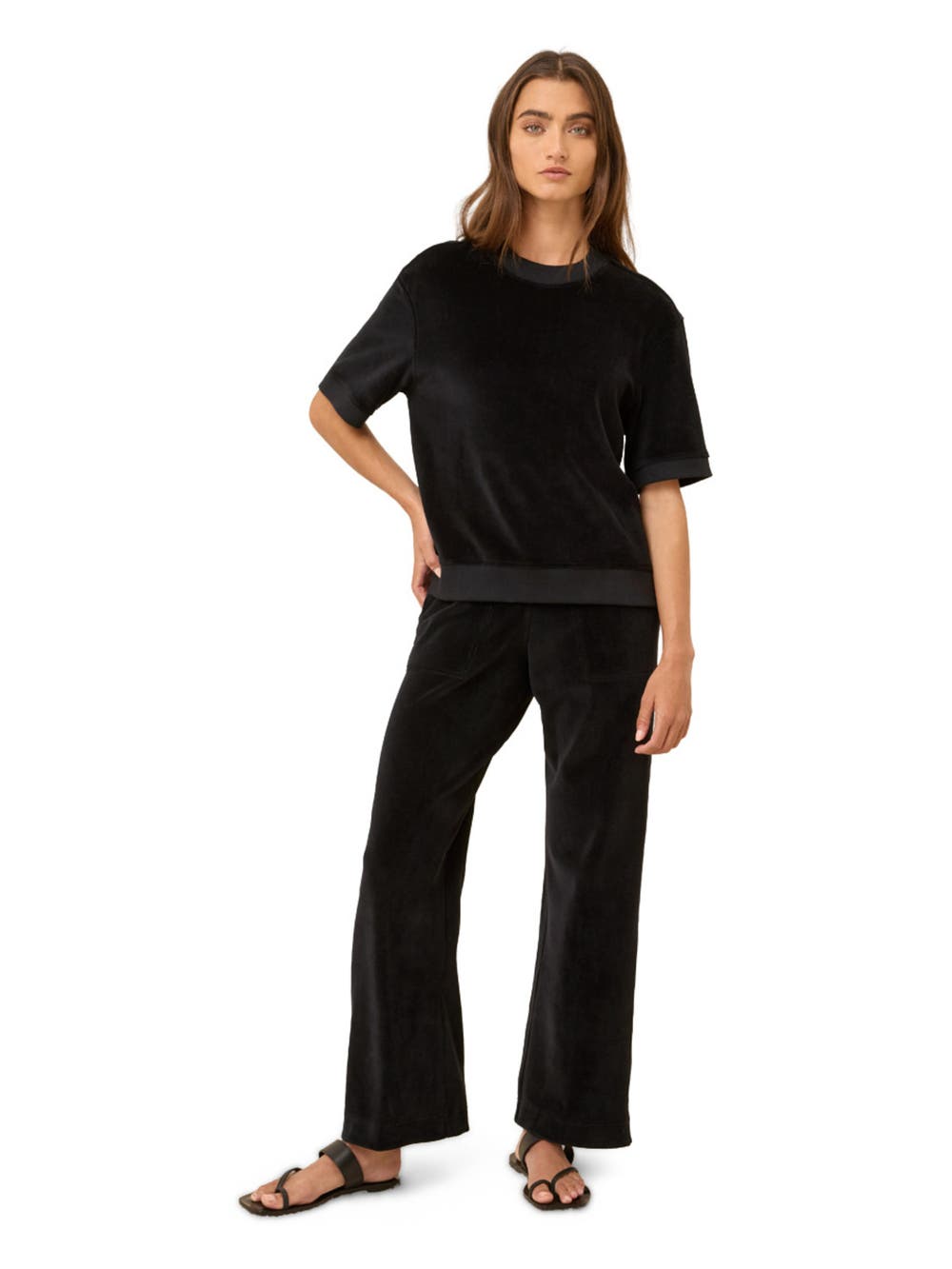
Quick stats: ~$68–$79 · GOTS organic cotton · Fair Trade Certified factory · stretch twill · sizes XS–XXL · machine wash.
Pact is the pick that stacks two verified marks — GOTS organic cotton and a Fair Trade Certified sewing factory — at a value price. The stretch twill adds a little give and structure, which makes it the most workwear-ready of the sub-$80 options. For a reader who cares about labor certification, not just fiber, this is the strongest value entry.
What reviewers praise: across Pact’s DTC and Nordstrom listings, reviewers cite easy machine-wash care, a comfortable stretch, and reliable everyday wear at a low price point.
Recurring caveats: it sits well below the near-cap floor, so we label it a value pick, not a near-cap one. Note also that Pact’s own storefront renders product images client-side, so the photo here is sourced from a stable retailer listing rather than Pact’s site. Fabric structure is modest — this is everyday twill, not a pressed dress trouser.
Best fit for: the reader who wants both organic fiber and factory-labor certification without stretching the budget.
Shop the Pact Organic Cotton Wide-Leg Pant →
Best Budget — Quince, Vintage Wash TENCEL Wide-Leg Pant (~$49.90)
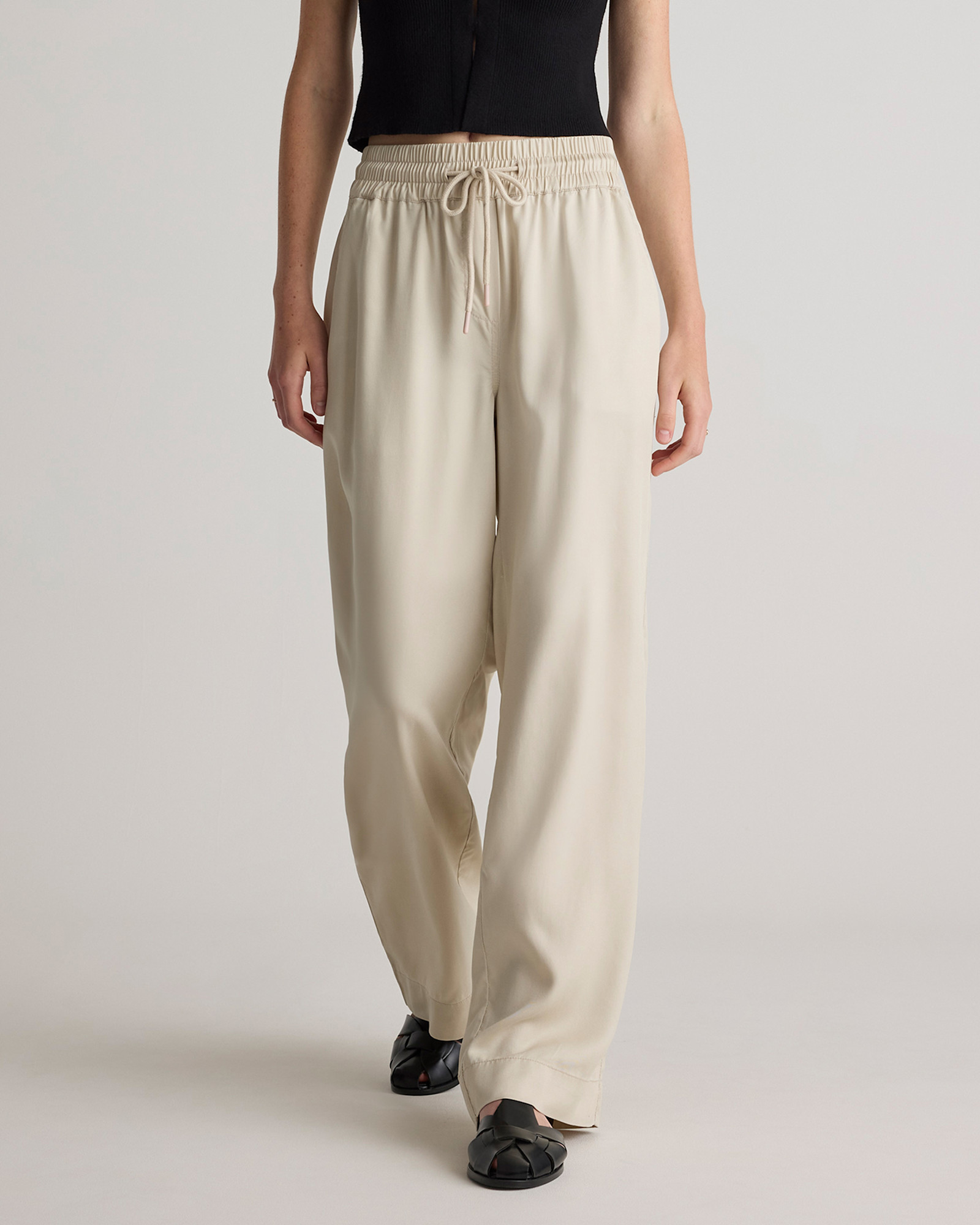
Quick stats: ~$49.90 · 100% TENCEL (brand-attested) · AZO-free dye · drawstring elastic waist · front and back pockets · made in Mumbai.
This is the cheapest way into a TENCEL wide-leg, and it comes with the biggest honesty asterisk in the guide. Per Quince’s product page the fabric is 100% TENCEL with AZO-free dye, and reviewers (around 238) praise the relaxed comfort and the price. But — and this matters for this persona — Quince holds no GOTS or third-party textile certification on this item; the low-impact story is the brand’s own account of its supply chain. Quince’s “factory-direct” transparency has drawn criticism precisely because it asks you to take the claims on trust.
What reviewers praise: comfort, the elastic drawstring waist, wrinkle and static resistance, and the standout price all recur in verified reviews.
Recurring caveats: no third-party certification, so we file the sustainability claim under brand-attested. Checkout is app- and site-only, which can limit affiliate coverage. And it is a value/budget silhouette, not tailored.
Best fit for: the strictly budget-focused reader who wants the TENCEL fiber and is comfortable evaluating a brand-attested claim on its own merits.
Shop the Quince Vintage Wash TENCEL Wide-Leg Pant →
Best Warm-Weather / Travel — Toad&Co, Taj Hemp Wide-Leg Pant (~$48.99 sale, reg. ~$95)
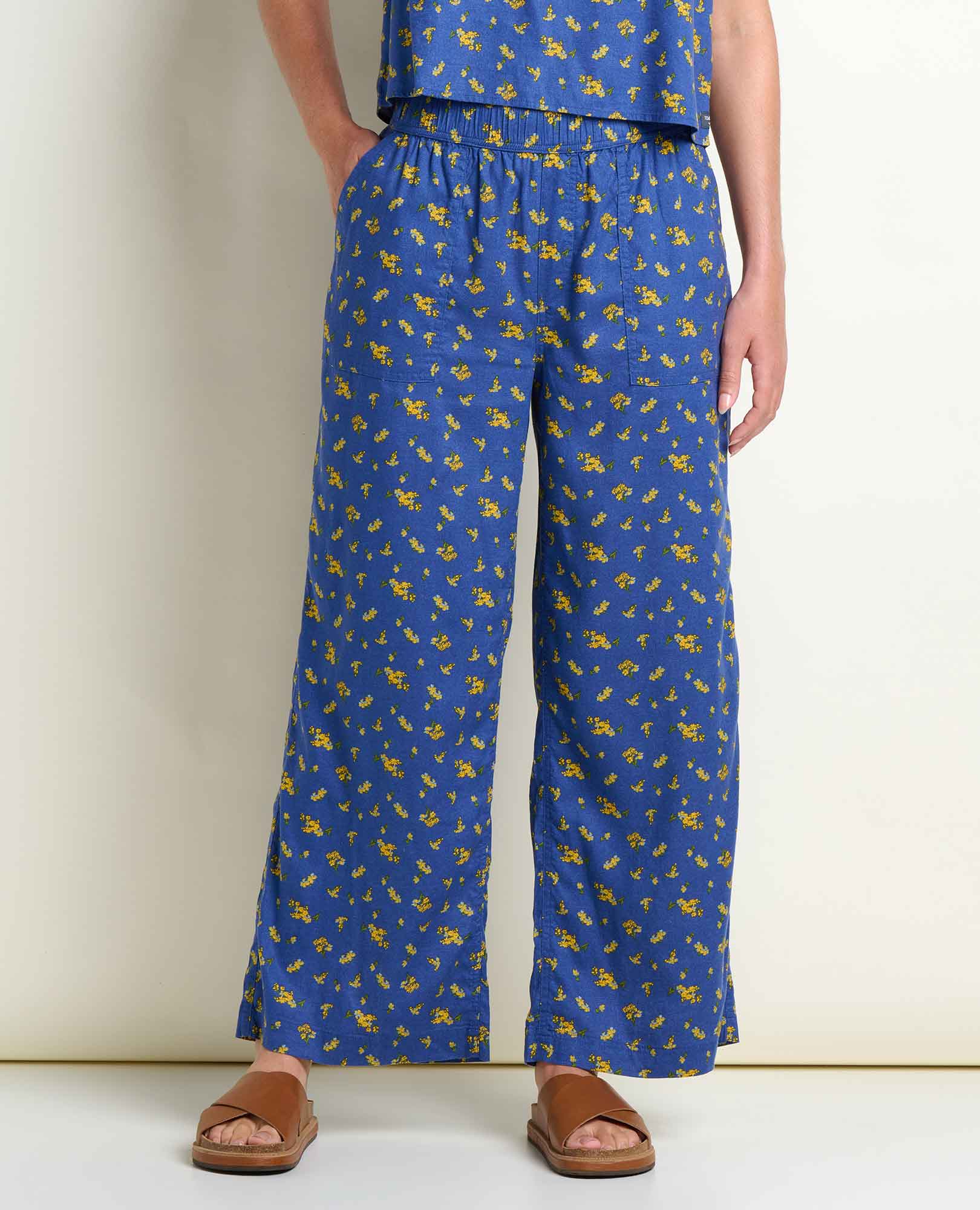
Quick stats: ~$48.99 on sale (regular ~$95) · 54% hemp / 44% TENCEL / 2% elastane · B Corp · 1% for the Planet · pull-on elastic waist, mid-rise ankle · sizes XS–XL.
Hemp is one of the more durable low-impact fibers, and this is the pick that leans into it. Per Toad&Co’s specs the blend is 54% hemp, 44% TENCEL, and 2% elastane, the brand is a certified B Corp and 1% for the Planet member, and it runs a ToadAgain resale program that keeps the pant in circulation after you are done with it. With a linen-like hand and wrinkle resistance, it is the travel-and-warm-weather option here.
What reviewers praise: across roughly 260 reviews the pant scores highly for comfort, breathability, and easy pull-on wear.
Recurring caveats: reviewer consensus is clear that it runs large — size down. A few note it can read slightly pajama-like. The $48.99 is a sale price against a regular of about $95, so confirm the current price at checkout. And the hemp blend is casual, not tailored.
Best fit for: the reader who wants a durable, travel-friendly hemp pant and values a brand with a resale and circularity program.
Shop the Toad&Co Taj Hemp Wide-Leg Pant →
Honest “Graduate” Picks — Over $150 (not carded, shown for transparency)
If your real priority is a sharply tailored trouser, the sub-$150 field leans casual, and honesty means pointing you upward rather than pretending otherwise. These are over the cap, so they are not scored picks — just transparent context.
Amour Vert — Victoire Wide-Leg Pant (~$225) is the most tailored option, with a high waist, full leg, and detachable belt. The blend is 52% poly / 45% RWS wool / 3% spandex with a 100% recycled-poly lining, ethically made in China. The honest trade-offs: it is over the cap and dry-clean only.
Eileen Fisher — Wide-Leg (organic cotton/TENCEL, ~$178) comes from a brand carrying GOTS, GRS, RWS, Bluesign, and FSC certifications and a strong size-inclusive range. A premium investment rather than a budget buy.
Everlane — The Utility Wide-Leg Pant (~$108–$118) is Everlane’s current organic-cotton option; the older, popular “Organic Wide-Leg Pant” at $98 has been discontinued and largely sold out, so treat the Utility as the live replacement and confirm price and stock at checkout.
The Cost-Per-Wear Case (and Why Circularity Matters Here)
For this persona, the smarter frame is cost-per-wear: price divided by realistic wears. A $138 GOTS pair worn twice a week across two fall-and-winter seasons — roughly 150 wears — pencils out under $1 per wear; a $49 budget pair worn as often lands near $0.33. Both are defensible. The difference is that the certified pair also buys verified fiber and, usually, construction that survives more washes.
Circularity extends that math. Toad&Co’s ToadAgain resale program and tentree’s trade-in and planting model both keep a garment moving instead of landfilled — the single biggest lever a sustainability-minded shopper controls. Between two similar picks, the one with a take-back pathway is the better long-run choice, and it can recover some of your spend later.
How to Choose a Sustainable Wide-Leg Trouser
Start with the certification that matches what you care about most. If your priority is the fiber, look for GOTS (organic cotton) or TENCEL (lyocell). If it is labor, look for Fair Trade Certified at the factory. If it is animal welfare, RWS wool. Company marks like B Corp and Climate Neutral are good supporting signals but are not a substitute for a product certification.
Next, match the silhouette to the use. The sub-$150 field here skews relaxed to lounge — MATE, tentree, Quince, and Toad&Co all lean casual — which is ideal for everyday, travel, and office-casual wear. If you need a pressed, tailored trouser for a formal office, budget upward to the graduate picks.
Then check fiber care against your life: organic cotton and hemp machine-wash and wear casually, TENCEL drapes softly but resists a sharp crease, and wool blends often mean dry cleaning. Finally, read the fit consensus before you size — Toad&Co’s “size down” is reviewer agreement that saves you a return.
FAQ
Can sustainable trousers really be under $150?
Yes. Every carded pick here is at or under $150, and four are under $110. The honest nuance is that certified wide-leg trousers cluster in a value band and a premium band, with a thin middle — so under $150 you are mostly shopping value to near-cap, with MATE (~$138) as the clearest near-cap, certified option.
Which sustainable fabric lasts longest?
Durability varies by construction, but among these fibers hemp and organic cotton are generally regarded as the most hard-wearing, while TENCEL prioritizes softness and drape over structure. Per general fiber guidance, a hemp or hemp-blend pant like the Toad&Co typically withstands the most wear.
How do I verify a brand’s sustainability claim?
Look for a third-party mark — GOTS, Fair Trade, TENCEL/Lenzing, RWS, GRS — rather than a self-described phrase. If a brand only “attests” to a practice on its own site (as with the Quince pick), treat it as unverified until a certification backs it. Company-level marks like B Corp indicate intent but do not certify the specific garment.
Are wide-leg pants still in for fall 2026?
Per sustainable-fashion and trend coverage across 2025 and 2026, wide-leg and relaxed silhouettes remain the dominant direction as the skinny-jeans era continues to fade, with barrel and wide cuts leading into fall. It is a low-risk silhouette to invest in.
Is a value-tier pick “less sustainable” than a near-cap one?
Not necessarily. Price reflects fabric, construction, and brand model as much as impact. A certified value pick (like the Pact GOTS and Fair Trade twill) can be as legitimately certified as a pricier one — the near-cap label here is about price position, not a sustainability score.
Editor’s Pick Recap
For the sustainability-minded reader shopping wide-leg trousers under $150 this fall: MATE the Label (~$138) is the near-cap, GOTS-certified pick to reach for if certification is your priority; tentree (~$88–$98) is the everyday certified-TENCEL workhorse; Pact (~$68–$79) stacks organic cotton and Fair Trade labor at a value price; Quince (~$49.90) is the cheapest TENCEL entry but comes with a brand-attested, uncertified asterisk; and Toad&Co (~$48.99 on sale) is the durable hemp travel pant with a resale program. If you need truly tailored, the honest move is to graduate to Amour Vert, Eileen Fisher, or Everlane above the cap.
This is an editorial research roundup, not personal hands-on testing. We synthesize sustainable-fashion coverage, brand-reported specifications and third-party certifications, and aggregate verified retailer reviews; we do not personally wear every product, and we distinguish certified evidence from brand-attested claims throughout. Prices are as of August 2026 — reconfirm at checkout, since several picks are on sale.